
Making Tax Digital for Freelancers and Sole Traders
The plain-English guide to MTD for Income Tax: what it is, when it kicks in, and how Keepr handles it for you.
Check if MTD affects youMaking Tax Digital (MTD) for Income Tax requires UK sole traders and landlords to keep digital records and send HMRC a quarterly summary of income and expenses, replacing the single annual Self Assessment return. It starts on 6 April 2026 for anyone whose qualifying income was over £50,000 in the 2024–25 tax year. Keepr is HMRC-recognised for sole trader self-employment income and sends quarterly updates and the final declaration straight to HMRC. It is not a paid feature: the free plan does it, and Pro is £9 a month.
Keepr has been listed on GOV.UK's software choices list since 28 August 2026, for sole trader self-employment income, and HMRC-recognised since 5 August 2026. Both are technical checks rather than endorsements. HMRC does not recommend any product or provider. Keepr appears on GOV.UK's list of software compatible with MTD for Income Tax.
What is Making Tax Digital?
MTD for Income Tax Self Assessment (MTD for ITSA) is HMRC's biggest shake-up to self-employed tax in decades. Instead of filing once a year, you'll submit a summary of your income and expenses to HMRC every quarter, plus a final declaration at year end. It's not optional, and the deadlines are closer than most freelancers realise.
MTD deadlines: when it kicks in
Thresholds are based on qualifying income, meaning gross income from self-employment and property before expenses, not profit. Each threshold is tested against a specific earlier tax year, which is the part most people miss.
6 April 2026
Over £50,000
If your qualifying income was over £50,000 in the 2024–25 tax year, you must keep digital records and send quarterly updates from 6 April 2026.
6 April 2027
Over £30,000
If your qualifying income was over £30,000 in the 2025–26 tax year, you come into MTD from 6 April 2027.
6 April 2028
Over £20,000
If your qualifying income was over £20,000 in the 2026–27 tax year, you come into MTD from 6 April 2028. Most full-time freelancers are in scope at this point.
If you're close to a threshold, assume you'll be affected. HMRC will not send individual reminders. You can check your own date on GOV.UK.
What MTD actually means day-to-day
Forget the jargon. Here's what changes in practice.
Keep digital records
Income and expenses must live in software that talks to HMRC directly.
Submit quarterly updates
Four times a year, send HMRC a summary of what you've earned and spent.
Final declaration
Once a year, replacing Self Assessment, you confirm everything and settle your tax.
Software does the sending
Your accounting software handles submissions through HMRC's API.
How Keepr handles MTD
Keepr is designed around MTD from the ground up, not bolted on as an afterthought.
- Track income as you raise invoices — everything's recorded automatically
- Log expenses instantly from your phone — photograph a receipt, it's done
- Quarterly updates submitted directly to HMRC — no manual steps
- Final declaration handled in Keepr — one place for everything
Keepr is MTD for ITSA software that connects straight to HMRC. Submit your quarterly updates and final declaration directly from your account.
Start submitting with Keepr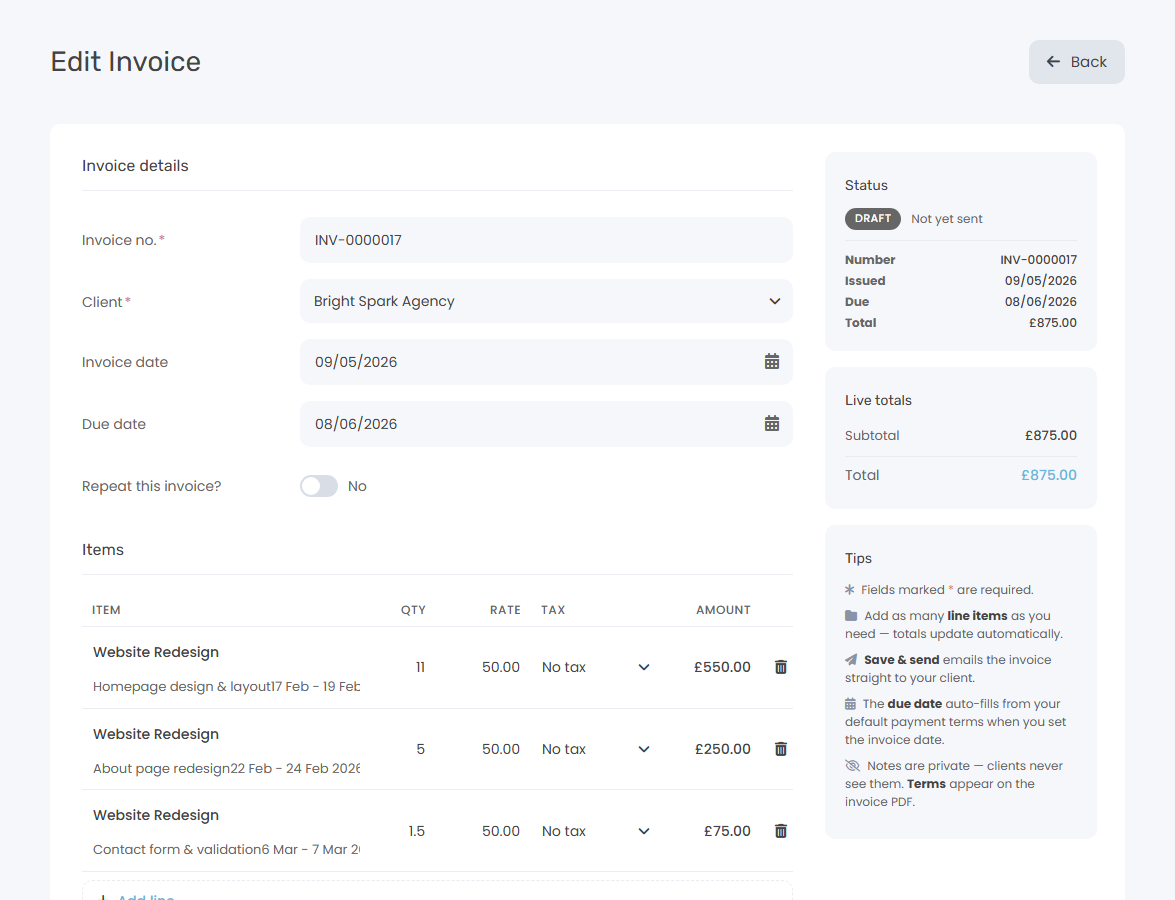
What does Keepr support for MTD?
Keepr covers sole trader self-employment income end to end: digital records, all four quarterly updates, and the final declaration. It does not handle UK property income, so landlords filing property income need different software. The full position, so you can check before you sign up:
Supported today
- Sole trader self-employment income and expenses
- Digital record keeping
- Quarterly updates sent to HMRC
- Final declaration (this replaces your Self Assessment return)
- In-product tax calculation
- Student Loan repayments
- Voluntary Class 2 National Insurance
In development by April 2027
- Employment (PAYE) income
- UK interest
- UK dividends
- Pension contributions
- Charitable giving (Gift Aid)
- Marriage Allowance
Not supported
- UK property / landlord income
- Construction Industry Scheme (CIS)
- Foreign income
- State pension and private pension income
- Capital Gains Tax
- High Income Child Benefit Charge
- Partner income (partnerships)
If you have self-employment income and property income, you are in scope for MTD on both, and Keepr on its own is not enough. That is worth knowing now rather than in the week before a deadline.
When are the MTD quarterly deadlines?
HMRC splits the tax year (6 April to 5 April) into four fixed quarters. You send one update per quarter, plus a final declaration after the year ends. The dates are the same every year, for every sole trader on MTD.
| Quarter | Period | Deadline |
|---|---|---|
| Q1 | 6 April – 5 July | 7 August |
| Q2 | 6 July – 5 October | 7 November |
| Q3 | 6 October – 5 January | 7 February |
| Q4 | 6 January – 5 April | 7 May |
You get just over a month after each quarter closes. HMRC can also let you align quarters to calendar months (1 April – 30 June and so on); the deadlines stay on the 7th either way, and Keepr shows whichever set applies to you.
Quarterly updates are cumulative
Each update is a running total since 6 April, not just that quarter. Q2 covers Q1 plus Q2; Q4 covers the whole year. This is what makes corrections painless. Spot a missing receipt after sending Q2 and the next update carries the corrected total automatically. You never resubmit an earlier quarter.
Cash basis or accruals?
Cash basis has been the default for sole traders since 6 April 2024. It counts money when it actually moves, so an invoice raised in May but paid in July lands in Q2. If you want traditional accruals accounting instead, you opt out by ticking a box on your Self Assessment return.
Keepr follows the accounting basis HMRC holds for your business, so your quarterly figures are sliced on the same basis HMRC expects. Where HMRC has no basis recorded against a business, Keepr keeps its existing behaviour rather than guessing.
Tax figures, thresholds and dates on this page were checked against HMRC guidance on .
Spreadsheets vs Keepr for MTD
If you're still on Excel, here's what changes when you switch.
What happens if you ignore MTD?
HMRC runs a points-based penalty system. Missing a quarterly update deadline earns a penalty point, and four points brings a fixed £200 penalty, with another £200 for each deadline you miss after that.
There are no penalties for missing a quarterly update deadline in the 2026–27 tax year, the first year it runs. That grace period covers quarterly updates only: the final declaration is in the penalty system from your first year, and late payment penalties are separate.
Beyond the fines: if you're still on spreadsheets when your threshold hits, you'll face a scramble to get compliant at the worst possible time, right before a submission deadline.
The freelancers who'll find MTD easiest are the ones already using software that handles it. That's the whole point of getting set up now.
Frequently asked questions
Everything freelancers actually ask about MTD. For the operational walkthrough, covering what you actually do week by week, see our step-by-step plain-English guide.
Do I need to register for MTD if I earn under £50,000?
Not yet. MTD for Income Tax starts on 6 April 2026 for anyone whose qualifying income was over £50,000 in the 2024–25 tax year. Over £30,000 in 2025–26 brings you in from 6 April 2027, and over £20,000 in 2026–27 from 6 April 2028. Below £20,000 no date has been confirmed, but building good habits now saves a scramble later.
Can I still use Excel for MTD?
No. Spreadsheets alone don't meet HMRC's MTD requirements because they can't submit data directly to HMRC. You'd need bridging software on top, which adds cost and complexity. Purpose-built software like Keepr handles everything in one place.
What counts as a quarterly update?
A quarterly update is a summary of your total income and allowable expenses for that three-month period. It's not a full tax return, so you're not calculating tax owed at this stage. You're just keeping HMRC updated on how the year is going.
Do I need an accountant to comply with MTD?
No. MTD is designed to be handled through software, not accountants. If you already manage your own Self Assessment, you can manage MTD yourself using the right tool. Keepr is built specifically for freelancers who do their own bookkeeping.
What are the MTD quarterly submission deadlines?
Using the standard quarterly periods, the deadlines are 7 August, 7 November, 7 February and 7 May, just over a month after each quarter closes. HMRC may allow you to align quarters to calendar months instead; the deadlines stay on the 7th either way, and Keepr surfaces the correct ones for your setup.
Is Keepr compatible with MTD for Income Tax?
Yes, for sole trader self-employment income. Keepr has been listed on GOV.UK's software choices list since 28 August 2026 and sends quarterly updates and the final declaration straight to HMRC. It does not handle UK property income, so landlords need different software for that.
How much does MTD software cost with Keepr?
Nothing extra. MTD works the same on the free plan as on Pro, with the same submissions and the same scope, so quarterly updates are not a paid feature. Pro costs £9 a month, or £84 a year, and adds automation like recurring invoices, automated reminders and no Keepr fee on Stripe card payments.
Does MTD use the cash basis or accruals?
Cash basis has been the default for sole traders since 6 April 2024, so most people are on it: income counts when the money arrives, not when you raise the invoice. You opt out to traditional accruals accounting by ticking a box on your Self Assessment return. Keepr follows whichever basis HMRC holds for your business.
What software do I need for MTD?
You need software that works with Making Tax Digital for Income Tax. Keepr connects directly to HMRC's API so your quarterly updates and final declaration are sent without manual steps or spreadsheet exports.
What if I have multiple income sources?
If you have self-employment income plus, say, rental income, both need to be reported under MTD once you cross the threshold. Keepr handles self-employment income and expenses. If your situation is more complex, an accountant is worth consulting for the specifics.
When should I start preparing for MTD?
Now, if you're within 12 months of your threshold. Getting your records into shape before the deadline is dramatically easier than migrating mid-year under pressure.
More than just MTD
Keepr handles your full freelance accounting workflow.
Invoicing
Create unlimited invoices, accept Stripe card payments, and track who's paid. Free forever.
Expense Tracking
Capture receipts from your phone and categorise everything for your tax return in seconds.
Time Tracking
Track billable hours by client and project, then convert them straight into invoice line items.
Not sure if MTD applies to you?
Take the 60-second quiz to find out exactly when MTD will affect you and what to do next.
Find out in 60 seconds whether MTD applies to you
Are you self-employed, a sole trader, or a freelancer in the UK?
What's your approximate gross income from self-employment per year?
How do you currently manage your records?
Do you have an accountant who handles your Self Assessment?
MTD for ITSA doesn't apply to you
MTD for Income Tax Self Assessment is for self-employed people. If you have rental income or other untaxed income, it's worth checking with an accountant whether other MTD rules apply to you.
Over £50k: you need to act now
MTD for ITSA applies to you from April 2026. You need software that connects directly to HMRC. Spreadsheets won't be enough. Keepr connects directly to HMRC and is ready to go. Get set up today and submit your first quarterly update directly from Keepr.
Get started with Keepr£30k–£50k: your deadline is April 2027
MTD applies to you from April 2027. You've got time, but freelancers who get set up early avoid the last-minute scramble, and build better habits along the way. Keepr is free to start and files straight to HMRC, so your records will be ready when your deadline arrives.
Try Keepr free£20k–£30k: your deadline is April 2028
If your qualifying income was over £20,000 in the 2026–27 tax year, you come into MTD from 6 April 2028. That is further off than most, but the threshold is tested against a tax year that has already started, so what you earn now decides it.
Try Keepr freeUnder £20k: no date yet
HMRC has confirmed thresholds down to £20,000, and has not set a date below that. If your income grows past £20,000 you come into MTD two years later, so digital records now cost you nothing and save a scramble if that happens.
Try Keepr freeAlready using accounting software
Good start. The question is whether your current software is actually MTD-ready. Many aren't, or charge extra for it. Keepr includes MTD submissions on every plan, with no add-ons required.
See how Keepr compares